It's a Tuesday night at Shinjuku Station and a woman in office wear is photographing a billboard. Not a brand ad — a portrait of a 22-year-old idol in soft pink lighting, signed off with hundreds of fan names in tiny print. She bows slightly, tucks her phone away, and disappears into the Yamanote line crowd. Around the corner, three teenagers are doing the same thing in front of a different idol's birthday board. By tomorrow morning, both ads will have racked up thousands of posts on X, all using the same word: 推し (oshi).
Oshi doesn't quite mean "favorite." It comes from the verb 推す (osu) — "to push, to back, to recommend." Your oshi is the person, character, or thing you actively champion to the world. You don't passively enjoy them; you push for them. Once you understand that one verb, a huge chunk of contemporary Japanese pop culture suddenly clicks into place.
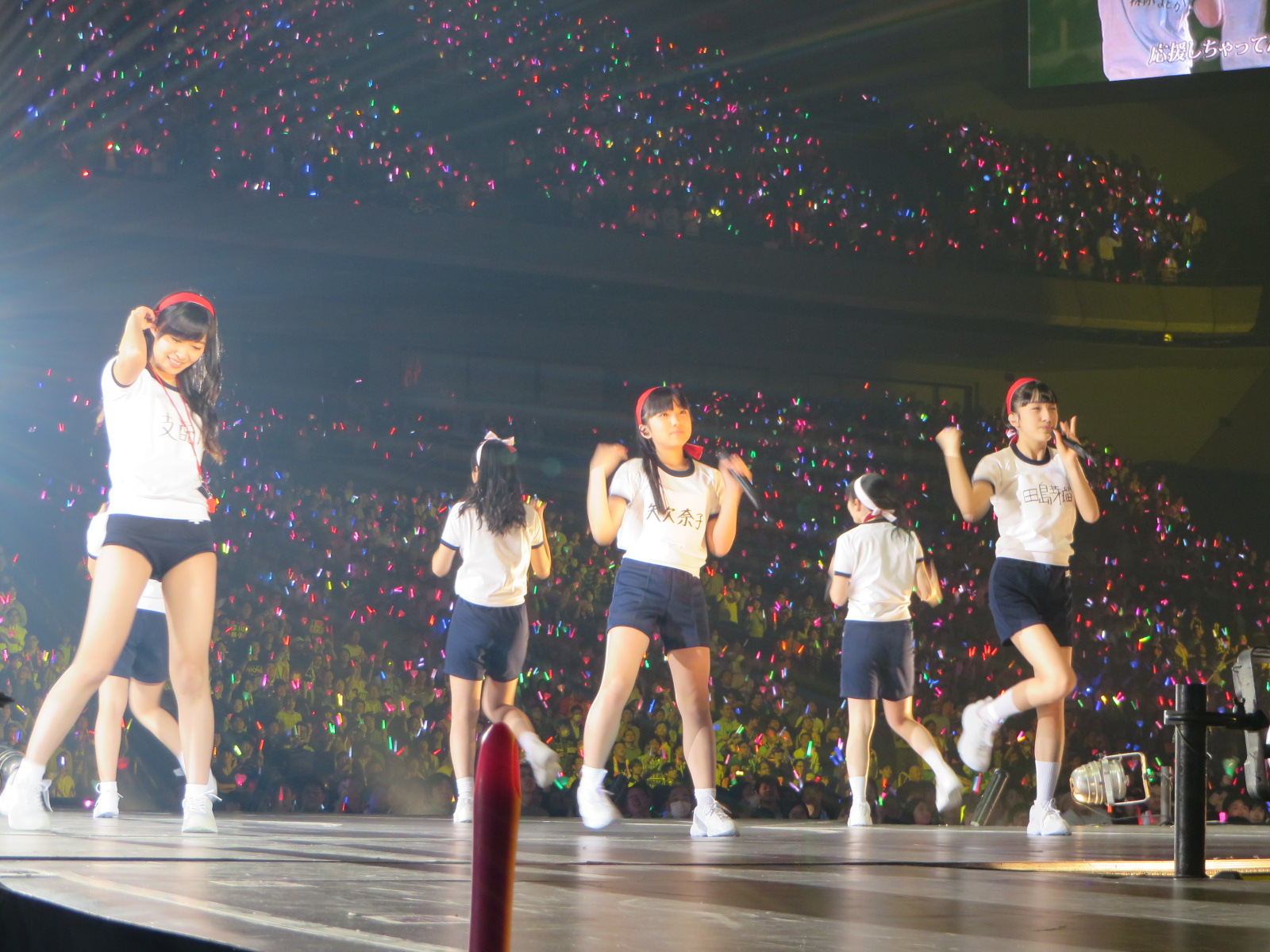
 AKB48 at their Spring 2024 concert in Yokohama — nearly two decades after the group's debut, the idol-fan rituals it codified now power a multibillion-dollar oshikatsu economy. Photo: TORU / Wikimedia Commons (CC BY 4.0).
From record-label slang to fan gospel
The word's been kicking around the music industry since the 1980s — labels would pitch a new artist to radio stations as "uchi no oshi" ("our pick of the month"). But its modern fan-slang form crystallized in the late '90s on 2channel, the legendary anonymous message board, among Morning Musume diehards who shortened "favorite member" into 推しメン (oshimen — "oshi member"). Then AKB48 happened. After the group launched its senbatsu sōsenkyō (general election) in 2009, where fans literally bought CDs to vote their oshimen into the next single's lineup, the word punched into the mainstream. By 2011 oshimen had earned a nomination for Japan's annual U-Can buzzword award.
A decade later, the verb mutated again into 推し活 (oshikatsu — "the activity of pushing your fave"), which got its own buzzword nomination in 2021. COVID lockdowns turbocharged it: with no concerts to attend, fans poured energy into streaming, merch, and online community, and writer Usami Rin's novella Oshi, Moyu ("Idol, Burning") won the 164th Akutagawa Prize and sold over 750,000 copies. Fan obsession had officially gone literary.
The vocabulary of devotion
Once you're in, the dialect gets specific fast. Are you 箱推し (hako-oshi — "box push," loving the whole group) or 単推し (tan-oshi, devoted to just one)? Is this person your casual fave or your 神推し (kami-oshi — "god push," the absolute one)? When you swap allegiance, that's 推し変 (oshi-hen). When you fall genuinely, helplessly in love? ガチ恋 (gachikoi — "serious love"). When your oshi does literally anything — sneezes, blinks, exists — you cry 尊い (tōtoi — "precious, sacred").
The activities sprawl just as wide. There's 現場 (genba) — "the scene," meaning every concert, fan meet, and theater show — with the elite badge of zentsū (全通) for fans who attend every single tour date. There's 推し色 (oshi-iro), your oshi's signature color, which dictates everything from your King Blade penlight (15+ programmable colors, swap mid-song) to the icing on your cafe pancake. There are 痛バ (ita-bag) totes plastered front-to-back in pin-back buttons, アクスタ (acrylic stand) figures posed at brunch, and 聖地巡礼 (seichi junrei) — pilgrimages to the real-world locations behind anime backdrops or an idol's hometown convenience store.
A ¥9.9 trillion feeling
Here's where it stops being cute. Yano Research Institute pegged Japan's broad oshikatsu economy at over ¥9.9 trillion (~$66 billion) in 2024, with narrower "oshikatsu spending" alone at ¥3.5 trillion — about 2.1% of Japan's total annual retail sales. Roughly 13.84 million people, around 11% of the country, identify as actively doing oshikatsu, dropping an average of ¥250,000 (~$1,600) per fan per year on tickets, merch, photocards, and crowdfunded subway ads.
And it's not just teenagers. VideoResearch puts the rate at 62.1% of Gen Z, 40.4% of millennials, and 27.1% of Gen X — and a 2024 Harumeku survey found 46% of women in their 50s now have an oshi they spend money on. The Ishiba cabinet has openly cited oshikatsu as a hoped-for engine of consumer growth. McDonald's Japan ran a "Live Fandom Feast" campaign in 2024 aimed squarely at this audience. Your auntie in Nagoya is, statistically, somebody's stan.
How it went global
Two pieces of media did most of the heavy lifting overseas. Oshi no Ko ballooned from around 9 million copies pre-anime to over 25 million in circulation by late 2025, and Ai Hoshino — its fictional dead idol — ranked #3 in a 2023 Benesse poll of the "people Japanese children most admire," behind only "friend" and "mother." Then YOASOBI's "Idol," the show's opening, became the fastest song in Japanese history to hit 100 million streams (five weeks), the first Japanese-language song to top Billboard Global Excl. U.S., and blew past 300 million YouTube views in record time. Suddenly the word oshi was everywhere, in every language, even when the people using it couldn't quite explain it.
Welcome to the scene
Now that you've got the verb, you'll start hearing it constantly — in K-pop spaces, in Genshin Discords, in the way your friend talks about a tennis player or a particular Tokyo bookshop or a single very photogenic capybara. The cultural import is simple: it's permission to love something out loud, organize your life around it a little, and find your people. If you've ever felt that pull — toward a member, a character, a voice actor, a baseball team, a Buddhist statue — congratulations. You already had an oshi. You just didn't have the word.
Cover image: AKB48 perform on stage as fans wave color-coded penlights — the visual signature of Japanese oshi culture. Photo: Rarayuno / Wikimedia Commons (CC BY-SA 3.0).
Comments0